
8 fabric catalogue designs for selling cloth by the metre
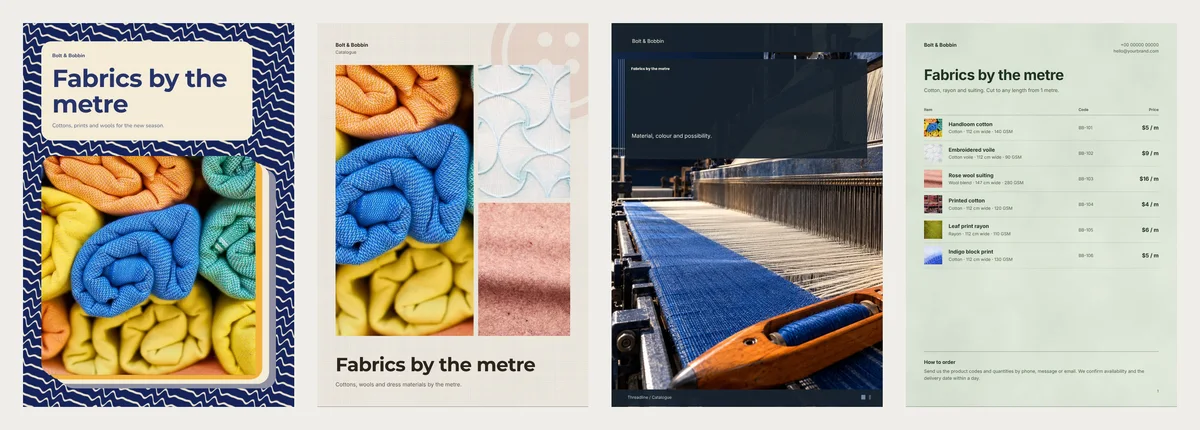
A good fabric catalogue design shows the weave up close and puts fibre, width and weight under every fabric. Here are eight free designs, each built with the same six fabrics.
"Is it pure cotton? How wide is it? Is it thick or thin?" A fabric buyer asks these before the price. A fabric catalogue that answers them saves you the same WhatsApp replies every day.
The right design helps too. A close-up shows the weave. A list suits a tailor who already knows your stock.
CatalogLeaf has 16 free fabric templates. Bolt & Bobbin, our sample shop, sells six fabrics. We put those six into eight of the designs.
The line every fabric needs
The six were cotton, voile, wool suiting, rayon and two prints. Under each one we typed one short line:
Cotton · 112 cm wide · 140 GSM
That line answers all three questions. The fibre says how it feels and washes. The width tells a tailor how many metres a dress needs.
GSM means grams per square metre: how heavy the cloth is. Our voile is 90 GSM and our suiting 280. Your supplier's invoice often shows it. To check it yourself, cut a piece 10 × 10 cm and weigh it. Multiply the grams by 100. Mass per square metre is what the ISO 3801 standard for woven cloth measures.
We typed each price as "$5 / m". The app leaves the "/ m" in place. Without it, a buyer cannot tell a price per metre from a price per piece.
Eight designs, side by side
Every design got the same photos, names, codes and lines. Then we saved each one as a PDF in two of the three qualities. Compact is the small file for WhatsApp. HD is for print.
| Design | What it makes | Pages | Compact | HD | Fibre line shown |
|---|---|---|---|---|---|
| Shade Card | Lookbook | 9 | 1.35 MB | 3.5 MB | under all 6 |
| Silk & Wool | Lookbook | 6 | 918 KB | 2.4 MB | under all 6 |
| The Loom Room | Catalogue | 6 | 808 KB | 2.6 MB | under all 6 |
| Block Print | Catalogue | 6 | 780 KB | 2.7 MB | under all 6 |
| Threadline | Catalogue | 13 | 696 KB | 2.6 MB | once each, on 3 pages |
| Chromatic Loom | Catalogue | 13 | 564 KB | 2.0 MB | once each, on 3 pages |
| Meter Rate | Price list | 1 | 109 KB | 271 KB | under all 6 |
| Mill Direct | Line sheet | 2 | 471 KB | 1.9 MB | under all 6 |
Big photos cost more than pages. Shade Card gives most fabrics a whole page, so it was the heaviest file. The two 13-page books made smaller Compact files than the 6-page catalogues.
When the cloth has to be seen
Prints, embroidery and wool sell on the weave and the colour. So the photo must be big. Shade Card and Silk & Wool give it the room.
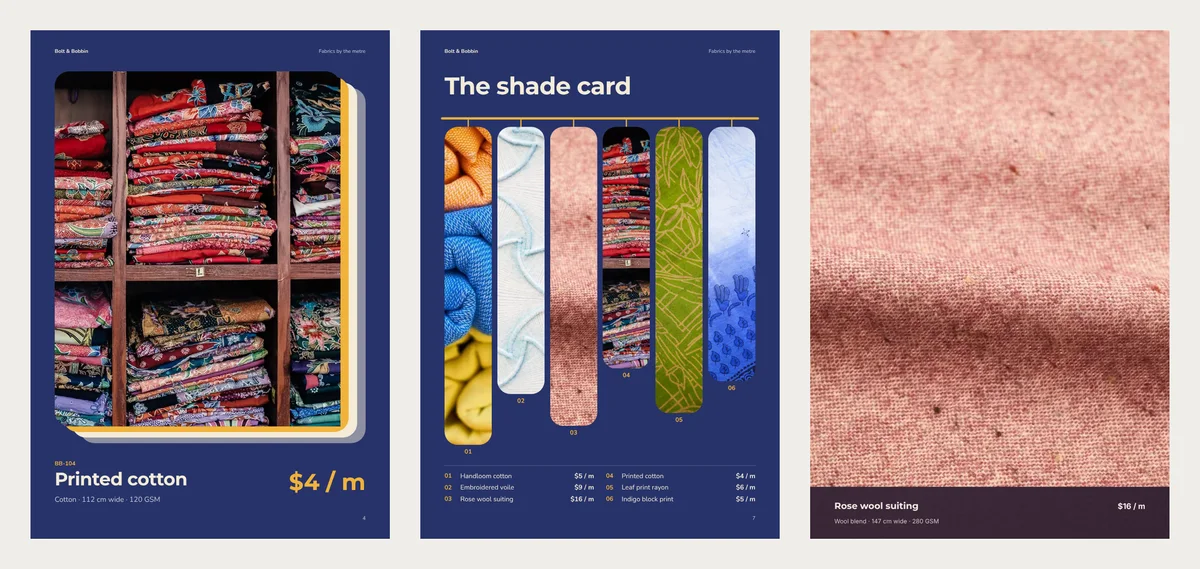
Shade Card is navy and saffron. Most fabrics get a page of their own, with the price in saffron. Its "shade card" page shows all six fabrics as tall strips. A short price list sits below. That page works like the card a mill sends to shops.
Silk & Wool fills most pages with one photo, edge to edge. The name, fibre line and price sit in a dark band at the bottom. It suits a small range of costly cloth.
Shoot these photos in daylight, flat on a table. Fill the frame with cloth, so the weave shows when a buyer zooms in.
When you sell a wide range
Many fabrics? Put four on a page. The Loom Room and Block Print do that, each fabric with its code, price and fibre line. Near the end, one fabric gets a page of its own.
One print in five colours? Add each colour as its own product, with its own photo and code. Buyers then order the colour by code.
The Loom Room is warm cream and red. Block Print is kraft paper and indigo, with a round photo on the cover. Its cover line says "Hand block-printed cottons", so change it if you sell more than that.
A swatch book to keep
Threadline and Chromatic Loom make 13 pages from six fabrics. They feel like a mill's sample book, with grid pages, single fabrics and a list at the end. Threadline is dark slate. Chromatic Loom is soft pink.
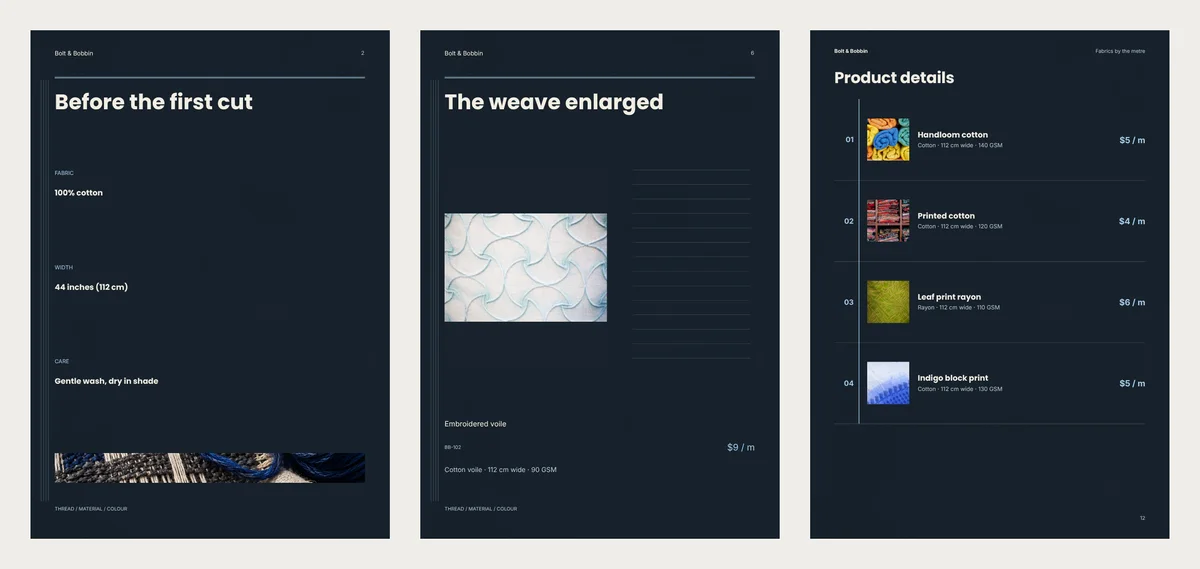
Here the grid pages show only the name, code and price. Each fabric's fibre line appears once, on its own page or in the "Product details" list.
Check one page before you send it. Threadline's page 2 is called "Before the first cut". Chromatic Loom has the same page on page 8, "Fabric particulars". Both keep the sample text with your fabrics: "100% cotton", "44 inches" and "Gentle wash". Our wool suiting is 147 cm wide, so that page was wrong for it. Write facts that are true for the whole range, or delete the page.
For the counter and for trade buyers
Choose Meter Rate for a one-page rate list. Each row has a small photo, the fibre line, the code and the price. It came to 109 KB, small enough to send to anyone. Print it for the counter too.
Choose Mill Direct when you sell to tailors and boutiques in bulk. It is a line sheet: a short list for trade buyers, with terms on the first page.
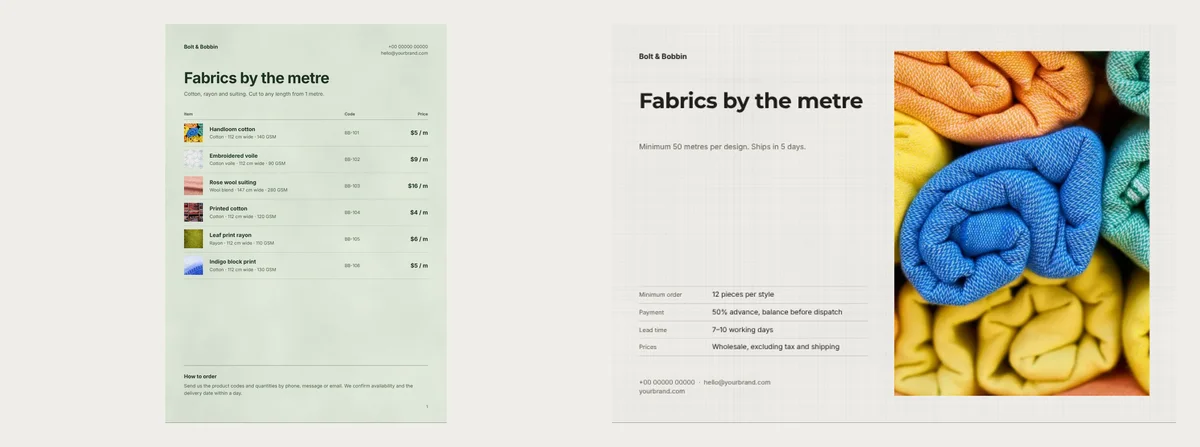
Mill Direct needs two fixes. Under the title, the sample says "Minimum 50 metres per design. Ships in 5 days." The table below says "12 pieces per style" and "7–10 working days". Fabric is sold by length, so pick one minimum in metres and one lead time. Then write them in both places.
Text that stays from the sample
Your photos, names, codes, prices and lines replace the samples. A few sample lines do not change. Read every page for these:
- The "About" text on most designs. It says you ship across India and send free swatches.
- The line under the title. You type the title, but every design keeps its own line below it.
- The "How to order" note on Meter Rate. It promises a reply "within a day".
- The phone, email and address on the last page.
Build yours
- Open a design, such as Shade Card, The Loom Room or Meter Rate. Click Use with my photos.
- Add one photo per fabric. Type its name and its price with the unit, like $5 / m. On a phone, tap More details for the code and description boxes.
- Put the fibre, width and GSM in the description box.
- Click Next: choose a design. Type your business name and a title, then click Create catalog.
- Click Customize (the pencil). Double-click each line from the list in the last section, and type your own.
Other fabric catalogues and rate lists are on the fabric catalogue templates and fabric price list templates pages.
Wash one metre of each new fabric before it goes in. If it shrinks, add that to its line.